· Alex Guven · AI · 8 min read
The 2025 Penetration Testing Landscape: Tools That Define Modern Cybersecurity
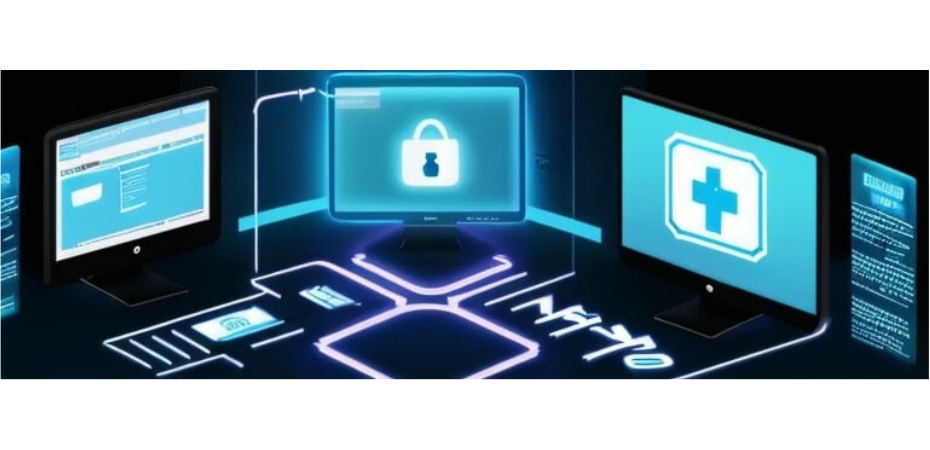
Cybersecurity has entered a new era. In the face of increasingly sophisticated cyber threats, relying on reactive measures is no longer enough. Modern organizations must embrace proactive, continuous testing strategies that mirror the behavior of real-world attackers. At the core of this approach is penetration testing.
Network Scanning: Building the Foundation
The first phase of any professional penetration test is reconnaissance. This stage is where testers discover systems, services, and entry points across the digital environment. Without a clear picture of what is connected to your network, there is no way to secure it.
Nmap, short for Network Mapper, has long been the industry’s preferred tool for this stage. It identifies live hosts, open ports, operating systems, and running services. Nmap’s versatility makes it suitable for both small internal scans and large-scale enterprise reconnaissance. For healthcare organizations, where legacy operating systems and unpatched medical devices are still prevalent, Nmap is often the fastest way to surface risks that could otherwise remain hidden for years.
Masscan offers complementary capabilities, prioritizing speed over detail. It can scan the entire IPv4 internet in minutes, making it a powerful option for external sweeps and attack surface mapping at scale. While not as precise as Nmap, it is ideal for quickly identifying large numbers of potentially exposed systems.
Together, these tools give security teams a detailed view of their networks and help lay the groundwork for deeper testing phases.
Vulnerability Assessment: Understanding Exposure
Once assets have been discovered, the next step is vulnerability scanning. These tools look for known weaknesses in software, misconfigurations in infrastructure, and deviations from best practices or compliance frameworks.
Nessus, developed by Tenable, remains one of the most relied-upon vulnerability scanners in the world. It is known for its comprehensive coverage, supporting over 250,000 plugins and tracking more than 100,000 CVEs. Nessus is frequently used in both internal audits and third-party assessments, particularly in environments with strict regulatory oversight.
Healthcare organizations often use Nessus to scan medical devices and EMR systems for vulnerabilities tied to HIPAA compliance. Its detailed reporting features allow IT teams to prioritize findings and address the most critical issues first.
OpenVAS, an open-source alternative, is widely used in educational institutions, smaller businesses, and security research labs. It offers strong baseline capabilities and is well suited for organizations with budget constraints. However, its coverage is slightly less extensive than Nessus, making it a better fit for supplementary scanning or environments without significant compliance requirements.
Other enterprise-grade platforms like QualysGuard and Rapid7 InsightVM are often selected for their scalability and integration with other security tools. These platforms support continuous scanning, real-time dashboards, and integration with ticketing systems and SIEMs, helping large organizations manage vulnerabilities as part of broader risk management strategies.
Exploitation Frameworks: Moving Beyond Detection
Finding a vulnerability is only the beginning. The real test is whether that vulnerability can be exploited in a way that would compromise systems, access sensitive data, or disrupt operations. This is where exploitation frameworks come into play.
Metasploit Framework is the most widely used exploitation toolkit in the cybersecurity industry. It provides thousands of modules for executing exploits, testing payloads, and simulating the behavior of real attackers. When a scanner identifies a known vulnerability, Metasploit allows a tester to validate the risk by launching a controlled exploit and observing the result.
Metasploit is especially powerful in post-exploitation scenarios, where a tester can escalate privileges, access additional systems, or extract credentials. This provides clear, concrete evidence of what an attacker could do if left undetected. Metasploit is also heavily used in training environments, such as Capture the Flag competitions and offensive security courses.
For more advanced red team operations, Cobalt Strike is the preferred tool. It supports stealthy, persistent operations through its Beacon payload and provides a collaborative platform for multiple operators. Cobalt Strike is often used in simulations of nation-state-level threats, where avoiding detection is part of the challenge. Many enterprises now require assessments that include Cobalt Strike as part of a full-scope adversary emulation.
Web Application Testing: Securing the Front Lines
With more services moving online, web applications have become the primary attack vector for many organizations. From login portals to APIs, every web-facing asset is a potential entry point for attackers. Testing these systems requires specialized tools with both automated and manual capabilities.
Burp Suite Professional, by PortSwigger, is widely regarded as the industry standard for web application penetration testing. It allows testers to intercept traffic, manipulate requests, and identify issues such as SQL injection, cross-site scripting (XSS), and broken authentication. Burp’s built-in scanner helps quickly uncover common vulnerabilities, while its manual tools enable in-depth analysis and exploitation.
For teams seeking a cost-effective, open-source alternative, OWASP ZAP offers many of the same core scanning capabilities. It’s especially useful for developers and DevSecOps teams aiming to integrate automated security checks into their build pipelines. While it may lack some of Burp’s advanced features, ZAP excels in early-stage security reviews and is a strong educational tool.
Another powerful solution is Nuclei, developed by ProjectDiscovery. Nuclei is a fast, flexible vulnerability scanner that uses a rich ecosystem of community-driven templates. It’s particularly well-suited for CI/CD environments and automated workflows, making it a favorite among teams focused on speed and customization. Tools like PurpleBox leverage Nuclei for rapid detection of misconfigurations and known CVEs during external scans. Nuclei complements broader vulnerability management strategies alongside scanners like Nessus and OpenVAS.
For enterprise environments, Acunetix (now part of Invicti Security) delivers robust automation capabilities for organizations managing large-scale web assets. It supports modern web technologies like SPAs, handles complex authentication flows, and integrates seamlessly with development pipelines, offering scalability and depth for mature security teams.
Credential Security: Proving the Risks of Weak Passwords
Despite years of awareness, weak or reused passwords remain one of the most common causes of breaches. Demonstrating this risk during a penetration test often has the most direct impact on policy change.
John the Ripper and Hashcat are the leading tools for password cracking. John is efficient and highly customizable, while Hashcat leverages GPUs for high-speed attacks. These tools are used when testers obtain password hashes from compromised systems, allowing them to demonstrate how quickly those credentials can be cracked.
In tests of corporate networks, cracking even a small percentage of user passwords often leads to full domain compromise. This underscores the need for strong password policies and multifactor authentication.
For testing live login portals, tools like Hydra and Medusa perform online brute-force and password spraying attacks. These tests help identify externally facing services that may be vulnerable to credential attacks, such as VPNs or email gateways.

Specialized Environments and Targeted Tools
Penetration testing has expanded beyond traditional IT systems. Today’s assessments often include cloud environments, Active Directory domains, wireless networks, and even medical devices.
Tools like BloodHound help testers map privilege escalation paths in complex Active Directory environments. By analyzing user permissions and group memberships, BloodHound can uncover the shortest route from a low-privilege user to domain administrator, information that is often missed in standard audits.
Aircrack-ng remains the leading suite for testing Wi-Fi security, including capturing handshakes, testing encryption, and identifying rogue access points. For industries like healthcare and retail, where sensitive data is transmitted over wireless networks, ensuring Wi-Fi is secured is a critical step in the security process.
Other tools like Impacket, Responder, and PowerShell Empire help simulate lateral movement and credential theft within Windows environments. These tools are essential for demonstrating how a compromise on a single system can quickly escalate to broader network access. While Empire has been a long-standing option, it is now considered outdated, and many organizations are shifting toward more modern alternatives such as Silver or Mythic, which offer improved capabilities and active development.
What to Expect from a Modern Penetration Test
Understanding these tools is helpful, but what matters most is how they are used. A modern penetration test should simulate real-world threats, provide clear findings, and prioritize recommendations based on business impact. It should go beyond simply identifying vulnerabilities to demonstrate risk in a tangible way that both technical and executive stakeholders can understand.
You should expect your penetration testing partner to use a combination of automated tools and manual techniques, tailored to the specific technologies and risks within your environment. You should also expect thorough reporting, with actionable remediation guidance, and a clear connection to compliance requirements or risk management objectives.

How PurpleBox Brings Innovation to Penetration Testing
At PurpleBox, we believe penetration testing should deliver more than just a report. As an AI-first cybersecurity company, we combine deep human expertise with intelligent automation to help organizations stay ahead of attackers.
We incorporate industry-leading tools such as Metasploit, Nessus, and Burp Suite into our engagements, but we go further by leveraging AI to correlate scan results, detect chaining paths, and reduce false positives, helping us act faster and smarter. For example, by applying AI-driven correlation, we’ve connected scattered low-risk findings into complete attack paths, revealing business-critical exposures that would have been missed by manual review.
PurpleBox understands that every organization is different. That’s why we tailor each engagement to the specific needs, assets, and compliance landscape of our clients. Whether you’re conducting your first penetration test or building out a mature offensive security program, our team delivers assessments that are comprehensive, contextual, and designed to evolve with your business.
As threats continue to advance, PurpleBox is committed to staying at the forefront of innovation , bringing together AI, offensive security expertise, and industry-specific insight to help you navigate the cybersecurity challenges of today and tomorrow.
Get in touch to learn how PurpleBox can help you build a more secure future.